AI agents don't enter a company in place of people: they enter in place of one specific part of the work, the part no one will miss. And in doing so they change processes, which is the thing that really matters.
In this article we line up what the data says, what we see in projects, and the method we follow when we enter a company, between training and platform.
2026 is the year of selection, not adoption
Adoption has already happened. According to "The State of AI" (McKinsey), 88% of organizations use AI in at least one function. The problem is something else: almost two-thirds have never gone beyond pilot projects, and MIT research cited in the same debate estimates that around 95% of generative AI pilots produce no measurable impact on the bottom line.
On the agents front, Gartner is even blunter: according to "Gartner Predicts Over 40% of Agentic AI Projects Will Be Canceled by End of 2027" (Gartner), more than 40% of agentic AI projects will be canceled by the end of 2027, mainly due to out-of-control costs and immature governance. And who does succeed? "State of AI Agents 2026" (Databricks) observes that organizations equipped with governance tools bring 12 times more projects into production than the others.
Selection, then, doesn't happen at the model level. Everyone has the models. It happens at something less photogenic: how work is organized, and under what rules.
Factor number one: redesigning processes
The most important data point of the year, for anyone working on these topics, is buried in a statistical analysis. In "The State of AI" (McKinsey), 25 organizational factors were analyzed to understand which ones distinguish companies that achieve significant economic impact from AI (about 6% of the sample) from all the others. The factor with the strongest contribution isn't budget, isn't technological sophistication, isn't the amount of data.
It's the intentional redesign of workflows. High-performing companies turn out to be roughly three times more likely than others to have substantially rethought their processes when introducing AI.
The difference lies in one question. Companies that stand still ask: "how can AI speed up the process we already have?". Those that get results ask: "if these capabilities exist, how should this work be redone?". It's a difference of posture before it's a difference of technology.
Processes have never stood still
It's worth remembering this, because it helps take the drama out of it: business processes have always changed. They went from paper to management software, from management software to the cloud, from the cloud to mobile. Every shift moved people's work upward, away from the mechanical part.
With agents, two things happen at once, and it's useful to tell them apart:
The first: existing processes get supercharged. The flow stays the same, but the low-value steps get absorbed by a digital colleague. It's the natural starting point of every project.
The second, deeper one: processes are born that previously made no sense. The systematic follow-up no one had time to do. Quality control on everything instead of on a sample. The report that didn't exist because putting it together cost a full day. "Tech Trends 2026" (Deloitte) calls this scenario the "silicon workforce" and estimates that by 2028 at least 15% of daily operational decisions will be made by digital colleagues, with people focused on oversight, compliance, and strategy. Deloitte also gives concrete examples of balance: there are large insurers who hand off repetitive administrative claims-management tasks to agents, while keeping people on every sensitive customer interaction.
You don't automate yesterday's organization. You design tomorrow's.
Poor work
In our process-mapping workshops we use a phrase people recognize instantly: poor work. It's the part of the day spent copying data from one system to another, chasing people who don't answer, reconciling spreadsheets, re-checking what someone else has already checked, answering the same question for the tenth time.
No one was hired to do that. And yet, in many roles, poor work takes up an enormous share of time, with a side effect the numbers don't capture: it keeps people away from the work they're skilled at and passionate about.
AI agents, done well, eat exactly that. Which is why the right question to ask in a department isn't "what can we automate?", which puts everyone on the defensive, but "what's the work no one would miss?". The answer always comes, and it's always precise.
How we enter a company: the method
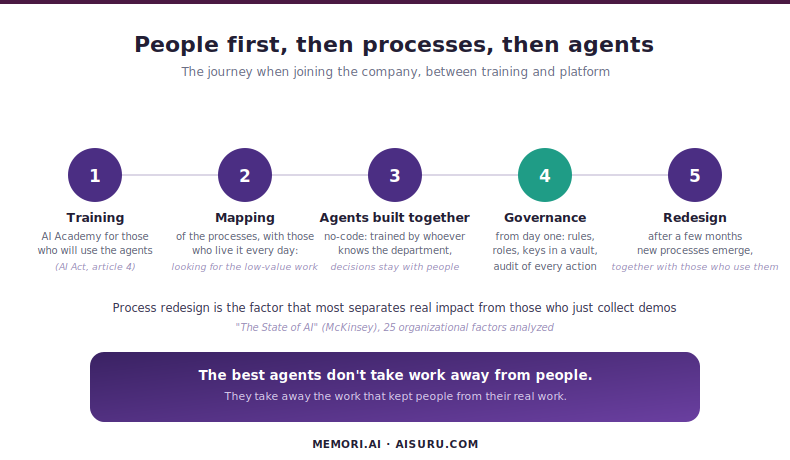
When we start a project, technology is the last thing we touch. The path we follow has five steps.
1. People first
We start with training, through our AI Academy: hands-on paths for those who will actually use the agents, from operational teams to managers. It's not a nicety: it's an AI Act obligation (Article 4 requires an adequate level of AI literacy for those operating these systems) and, above all, it's the condition for everything else to work. An organization that knows what agents can and can't do makes better decisions at every subsequent step, and is far less afraid.
2. Processes are mapped with the people who live them
Not on the org chart: in the departments. Whiteboard, sticky notes, and the people who do that process every day. The experience is consistent: no consultant knows the work better than the person who does it, and no map drawn from above survives contact with reality. In these sessions we identify the poor work and choose where to start: one process, not twenty.
3. Agents are built together
AIsuru is a no-code platform for exactly this reason: the department's agent is instructed by the people who know the department, with our support alongside them. We teach people how to build them, we don't hand over closed boxes. And the design always keeps decisions with people: on the topics that matter the agent answers with verified, approved content; where there's no certain answer it hands off to a human; and important actions require oversight.
4. Governance from day one
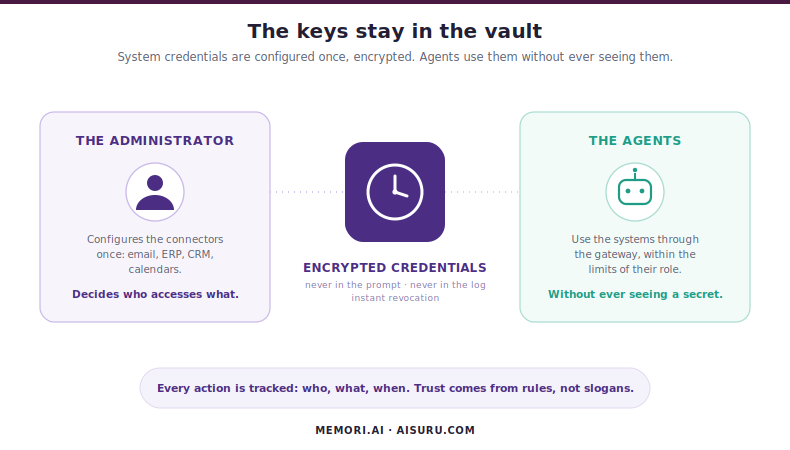
Behavioral rules defined at the organization level and inherited by every agent, roles and permissions that decide who accesses what, system credentials kept encrypted and never exposed to the models, tracking of every action, visible consumption, immediate revocation. This isn't preventive bureaucracy: it's the reason people trust the system. Cooperation between human and digital colleagues is born from trust, and trust is born from rules, not slogans. There's also a benefit that comes later: when the rules live in the configuration, governance documentation stops being a PDF that goes stale and becomes a snapshot of the system's real state, always up to date, with the gaps between what the organization declared and what the systems actually enforce visible to whoever governs it.
5. After a few months, the redesign
Once poor work disappears and trust has settled in, the second kind of opportunity emerges: new processes. It's the most creative moment of the journey, and it's no coincidence that it's the moment when department staff, by now trained and comfortable with the tool, propose more ideas than the project can realistically deliver. It's also, according to McKinsey's data, the moment where the difference is decided between a project that pays for itself and one that transforms the company.
Human-AI cooperation, in practice
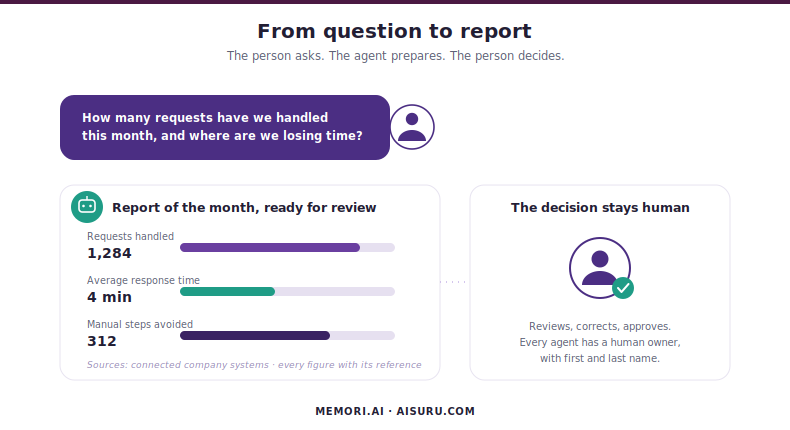
What happens to people, at the end of this journey? The empirical answer is: they level up. Those who used to execute become supervisors and designers of their own process. The "2026 Work Trend Index: Agents, human agency and opportunity" (Microsoft) describes the same shift on a global scale: human value migrates toward defining intent, judging quality, and designing how work gets done between people and agents.
In our projects this principle takes a concrete, non-negotiable form: every agent has a named human owner. Like any colleague entrusted with a piece of the business. It's the operational version of the human oversight the AI Act requires, and it's also, quite simply, organizational common sense.
Proof, not promises
One last thing, because the reader of this blog is often someone who has to choose a vendor. Everything we've described, from the method to the governance, any company can talk about. What makes the difference is who can prove it: that's why we completed a path of six third-party-verified attestations, including ISO/IEC 42001 certification, the international standard for artificial intelligence management systems aligned with the AI Act, plus ISO/IEC 27001, 27017, 27018, ISO 9001, and NIS2 compliance. For the customer, this isn't a detail: the AI Act and NIS2 look at the value chain, and the buyer's compliance also depends on the supplier's.
Where to start
If this article should leave you with just one thing, it's the question to bring to your next management meeting: what's the work, in our departments, that no one would miss?
That's where you start: people first, then processes, then agents. In the right order.
If you want to see how it works for your case, discover the AI Academy paths. And if you'd rather start with a conversation, [write to us].
Sources
- "The State of AI" (McKinsey): https://www.mckinsey.com/capabilities/quantumblack/our-insights/the-state-of-ai
- "Gartner Predicts Over 40% of Agentic AI Projects Will Be Canceled by End of 2027" (Gartner): https://www.gartner.com/en/newsroom/press-releases/2025-06-25-gartner-predicts-over-40-percent-of-agentic-ai-projects-will-be-canceled-by-end-of-2027
- "State of AI Agents 2026" (Databricks): https://www.databricks.com/resources/ebook/state-of-ai-agents (non-gated summary: https://www.databricks.com/blog/enterprise-ai-agent-trends-top-use-cases-governance-evaluations-and-more)
- "Tech Trends 2026" (Deloitte), agentic AI chapter: https://www.deloitte.com/us/en/insights/topics/technology-management/tech-trends/2026/agentic-ai-strategy.html
- "2026 Work Trend Index: Agents, human agency and opportunity" (Microsoft): https://www.microsoft.com/en-us/worklab/work-trend-index/agents-human-agency-and-the-opportunity-for-every-organization
- "The GenAI Divide: State of AI in Business 2025" (MIT NANDA), via Fortune coverage: https://fortune.com/2025/08/18/mit-report-95-percent-generative-ai-pilots-at-companies-failing-cfo/